Don't Just Lose Weight. Improve Your Body!

Why Building Muscle Matters When You’re Taking a GLP-1 for Weight Loss
Losing weight is only part of the goal. Preserving the muscle underneath it may be just as important.
GLP-1 medications have changed the weight-loss landscape. For many people, medications such as semaglutide and tirzepatide can make it considerably easier to reduce food intake and lose excess body weight.
But there is an important question that doesn't show up on the bathroom scale:
When you lose weight, what exactly are you losing?
Weight loss can come from several sources, including body fat, water and lean tissue. Lean tissue includes skeletal muscle, but it also includes other tissues and body water. Therefore, a reduction in measured "lean mass" should not automatically be interpreted as a loss of muscle.
Still, preserving muscle during significant weight loss deserves attention.
Why?
Because muscle isn't simply about looking toned. Muscle helps you walk, climb stairs, lift groceries, get out of a chair, maintain balance and remain physically independent.
And when weight loss is accompanied by resistance training and adequate nutrition, research suggests it is possible to shift the equation toward losing more fat while better protecting lean tissue and strength. A 2025 systematic review and meta-analysis found that adding resistance exercise to dietary weight loss helped preserve fat-free mass, increased fat loss and improved muscular strength compared with diet alone.
The goal isn't simply to become lighter. It's to become healthier, stronger and more capable while losing excess fat.
What Does a GLP-1 Actually Do?
To understand why muscle deserves attention, it helps to understand what happens when a GLP-1 medication is working.
GLP-1-based medications influence several signals involved in appetite, fullness and blood-sugar regulation. They can reduce hunger, increase feelings of fullness and, depending on the medication, slow the movement of food through the stomach.
The practical result is relatively simple:
You tend to eat less.
That reduction in food intake creates an energy deficit. The body then has to draw on stored energy to meet its needs.
Much of that stored energy comes from body fat—which is exactly what we want during intentional weight loss.
But the body doesn't have a switch that says:
"Burn fat and leave muscle completely alone."
Some lean tissue can be lost during weight reduction, whether the weight loss comes from dieting, lifestyle changes or medication-assisted weight loss.
Body-composition research with tirzepatide illustrates this point. In a DXA substudy of SURMOUNT-1, participants receiving tirzepatide lost substantially more body weight and fat mass than those receiving placebo. Approximately 75% of the weight lost was fat mass and 25% was lean mass.
That doesn't mean a quarter of the weight lost was necessarily skeletal muscle. Lean mass is not the same thing as muscle mass.
The important message is that significant weight loss can involve both fat and lean tissue.
Why Could Muscle Be Lost During Weight Loss?
There are several reasons.
1. You're eating less
This is one of the main reasons.
If your appetite drops substantially, your total calorie intake may fall considerably. That's helpful for weight loss, but eating less can also make it harder to consume enough protein and other nutrients needed to maintain muscle.
2. You may be eating less protein
Protein supplies amino acids—the building blocks your body uses to repair and maintain muscle tissue.
When appetite is low, it's easy to eat a small meal that provides relatively little protein.
For someone trying to preserve muscle during weight loss, what you eat becomes particularly important when you're eating less overall.
3. You're losing body weight
The body adapts to a lower energy supply.
During prolonged calorie restriction, the balance between building and breaking down muscle proteins can shift. Without adequate protein and a reason for the muscles to remain strong, some lean tissue may be lost.
4. You may be moving less
This is an often-overlooked issue.
Someone taking a GLP-1 may find that they are eating less but also becoming less physically active.
And muscles follow a basic principle:
Use them or gradually lose some of their capacity.
This is particularly relevant as we get older, because maintaining muscle and strength becomes increasingly important for mobility and independence.
Why Does Muscle Matter So Much?
If your primary goal is weight loss, it can be tempting to think:
"If the number on the scale is going down, I'm succeeding."
But your scale doesn't tell you how strong you are.
It doesn't tell you how easily you can climb stairs.
It doesn't tell you whether you can carry your luggage.
And it certainly doesn't tell you whether you will be able to get yourself up from the floor if you fall.
Muscle has important functional and metabolic roles. Maintaining muscle and strength supports the physical abilities that make everyday life easier.
Muscle helps you:
Walk and climb stairs
Lift and carry objects
Get up from a chair
Maintain balance and stability
Support posture
Perform everyday activities
Maintain physical independence
Handle the demands of exercise and activity
There is another reason this matters: aging itself is associated with gradual loss of muscle and strength.
That means someone in midlife or later adulthood who is losing weight has two things to consider at the same time:
Lose unnecessary body fat — while protecting the muscle you already have.
Weight Loss vs. Muscle-Preserving Weight Loss
Traditional focus | Muscle-conscious approach |
Watch the scale | Watch body composition and strength |
Eat less | Eat enough nutrient-dense food |
Focus primarily on calories | Pay attention to protein and overall nutrition |
Do more cardio | Include resistance training |
"Lose weight" | Lose excess fat while preserving muscle |
Exercise to burn calories | Exercise to improve strength, function and health |
This doesn't mean cardio or walking should be abandoned. They remain valuable forms of physical activity.
It means resistance training deserves a place at the table.
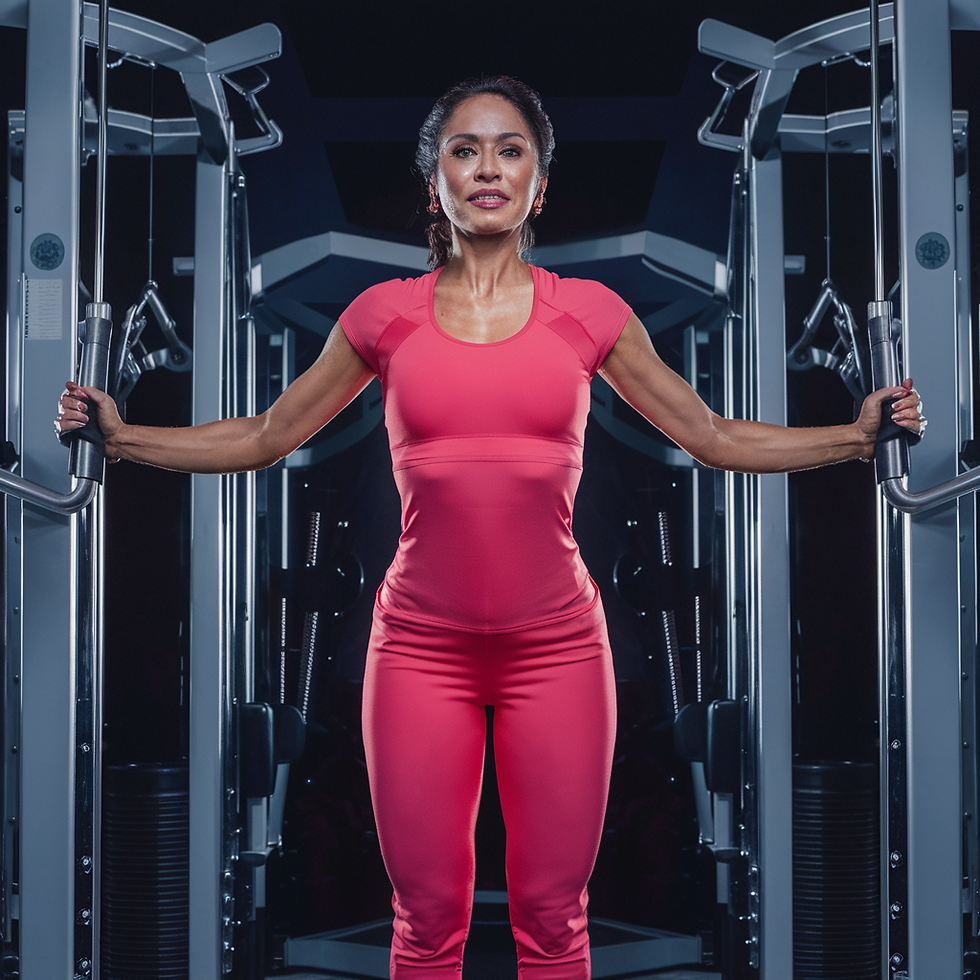
Resistance Training: The Muscle-Preservation Signal
If there is one exercise strategy that deserves special attention during GLP-1-assisted weight loss, it is resistance training.
Resistance training includes exercises performed against some form of resistance:
Dumbbells
Resistance bands
Weight machines
Cables
Body weight
Other forms of resistance
You don't have to become a bodybuilder.
You don't have to lift enormous weights.
And you don't have to spend hours in a gym.
The purpose is to give your muscles a clear message:
"This tissue is still needed."
Here's what happens inside the muscle.
When you challenge a muscle against resistance, you create mechanical tension. That tension triggers signals within the muscle that tell the body it needs to adapt.
After the workout, the body increases the process of muscle protein synthesis—essentially repairing and rebuilding muscle proteins.
With repeated training, adequate nutrition and recovery, the muscle becomes better equipped to handle the work.
This can result in greater strength and, depending on the training and nutrition, increased muscle size.
Think of resistance training as sending the body a very specific instruction:
We're losing weight, but we still need this muscle.
What Does the Research Tell Us?
This isn't simply a theory.
A 2025 systematic review and meta-analysis examined 25 randomized controlled trials involving more than 1,600 adults with overweight or obesity who were undergoing dietary weight loss. Researchers compared weight-loss programs that included resistance exercise with diet-only approaches.
The results were notable.
Resistance exercise:
Helped protect fat-free mass
Produced greater fat loss
Improved muscular strength
Did not significantly change the amount of total body weight lost
That last point is particularly interesting.
The people doing resistance training did not necessarily lose more pounds overall.
Instead, the composition of the weight they lost was more favorable.
That is an important distinction.
The scale might say:
"You lost 20 pounds."
But the more meaningful question is:
"How much of that weight came from fat, and how much came from lean tissue?"

Protein: Give Your Muscles the Building Blocks
Resistance training provides the stimulus.
Protein provides many of the raw materials.
When you are eating fewer calories, protein becomes particularly important because you're trying to maintain muscle while the body is in an energy deficit.
Good protein sources include:
Eggs
Fish and seafood
Poultry
Lean meats
Greek yogurt
Cottage cheese
Tofu and other soy foods
Beans and legumes
If appetite is significantly reduced by medication, it can be useful to think about protein before filling the plate with foods that provide fewer nutrients per bite.
However, there isn't one protein prescription that is appropriate for everyone. Protein requirements can vary based on body size, age, activity level, kidney health and other medical factors.
If you're using a GLP-1 medication, your healthcare professional or a registered dietitian can help determine an appropriate intake for your individual situation.
What Should a Muscle-Building Program Look Like?
It doesn't have to be complicated.
A well-rounded resistance program should challenge the major muscle groups and include movements such as:
Movement | Examples |
Squat / Sit-to-Stand | Chair squat, body-weight squat |
Push | Wall push-up, chest press |
Pull | Resistance-band row, seated row |
Hinge | Hip hinge, appropriate deadlift variation |
Carry | Farmer carry, loaded carry |
Core / Stability | Plank, anti-rotation exercises |
For someone new to resistance training, starting with manageable resistance and learning proper technique is more important than lifting heavy.
Then comes progressive overload.
That simply means gradually asking the muscles to do a little more over time.
That might mean:
A little more resistance
A few additional repetitions
Better control
More challenging variations
Improved range of motion
The body adapts to the demands placed upon it.
If the demand never changes, the stimulus eventually becomes less challenging.
Don't Forget Recovery
Muscles don't become stronger while you're actually lifting the weight.
The workout provides the stimulus.
Recovery is when the body does much of the repair and adaptation.
That means a muscle-building strategy also needs:
Resistance training + protein + adequate nutrition + recovery + consistency
Sleep and recovery days matter.
So does avoiding the temptation to believe that more exercise is always better.
The goal is to create a sustainable routine that can continue throughout the weight-loss journey and beyond.
The Bigger Picture: Don't Just Lose Weight. Improve Your Body.
GLP-1 medications can be valuable tools for people who need help losing excess weight.
But medication is only one part of the equation.
A more complete approach looks something like this:
GLP-1 medication
Helps reduce appetite and food intake.
Nutrition
Provides protein and essential nutrients while supporting appropriate weight loss.
Resistance training
Provides the stimulus to preserve and build muscle and strength.
Everyday movement
Helps maintain mobility and physical activity.
Recovery
Allows the body to repair and adapt.
Together, these strategies address something the bathroom scale cannot measure:
the quality of the weight you're losing and the physical capability you're maintaining.
The Bottom Line
If you're taking a GLP-1 medication for weight loss, watching the scale is understandable.
But don't let the scale become the only measure of success.
The goal should be to reduce excess body fat while protecting muscle, strength and physical function.
Research shows that resistance exercise during weight loss can help preserve fat-free mass, promote greater fat loss and improve strength.
And the principle is remarkably simple:
The medication helps make weight loss possible.
Nutrition supplies the building blocks.
Resistance training tells your body to keep using—and strengthening—the muscle.
So as the number on the scale goes down, don't forget to pay attention to something else:
How strong are you becoming?
Because successful weight loss isn't just about having a smaller body.
It's about having a healthier, stronger body that can support you for years to come!
Live with Vitality!
The LV Team


Comments